Holidays
Christmas in the U.S.: Federal Holiday Rules, What's Open and Where the Traditions Come From
Christmas Day is a federal holiday; Christmas Eve usually isn't. Here's when the next Christmas falls, how the weekend rule works, what's open, and how Santa and NORAD's Santa tracker became American traditions.

When is Christmas, and who gets the day off
The next Christmas is on Friday, December 25, 2026. December 25 is one of the 11 federal holidays set by law (5 U.S.C. § 6103), so federal offices, the Postal Service and most banks are closed.
Private employers don't have to give the day off. Federal law also doesn't require extra pay for working on a holiday: holiday pay depends on company policy or a union contract.
When December 25 falls on a Saturday, federal employees get Friday, December 24 off; when it falls on a Sunday, the holiday moves to Monday, December 26. That's what happens in 2027: Christmas is on a Saturday, so the federal holiday is observed on Friday, December 24.
Christmas in the coming years
| Year | Date | Note |
|---|---|---|
| 2026 | Friday, December 25, 2026 | long weekend |
| 2027 | Saturday, December 25, 2027 | observed Friday, December 24 |
| 2028 | Monday, December 25, 2028 | long weekend |
| 2029 | Tuesday, December 25, 2029 | bridge with Monday |
| 2030 | Wednesday, December 25, 2030 | midweek |
Christmas Eve: a day off only sometimes
December 24 isn't a federal holiday. Presidents can still give federal employees the day off by executive order, and several recent ones have: Christmas Eve was a day off in 2018, 2019, 2020 and 2024, and in 2025 federal workers got both December 24 and December 26.
These orders usually come out only a week or two before Christmas, so it's worth checking each year.
Why December 25
The Bible doesn't give a date for the birth of Jesus. The oldest surviving record that places it on December 25 is the Chronograph of 354, a Roman calendar with the entry natus Christus in Betleem Iudeae ("Christ born in Bethlehem of Judea").
A popular theory says the date was picked to replace pagan festivals such as Sol Invictus. Historians call that too simple: early Christian writers never mention those festivals when they discuss the date. Another explanation is a calculation: an old tradition placed Jesus' conception on March 25, and nine months later is December 25.
From banned to federal holiday
Christmas wasn't always welcome in America. In 1659, the Massachusetts Bay Colony made celebrating it an offense punishable by a five-shilling fine; the Puritans saw the feast as unbiblical and rowdy. The ban was repealed in 1681.
Almost two centuries later, on June 28, 1870, President Ulysses S. Grant signed the law that made December 25 a holiday for federal employees in Washington, D.C., along with New Year's Day and the Fourth of July. Later laws extended it to federal workers across the country.
Timeline
- 354A Roman calendar, the Chronograph of 354, records the birth of Christ on December 25.
- 1659The Massachusetts Bay Colony bans Christmas celebrations. The ban lasts until 1681.
- 1823The poem "A Visit from St. Nicholas" gives Santa his sleigh and eight reindeer.
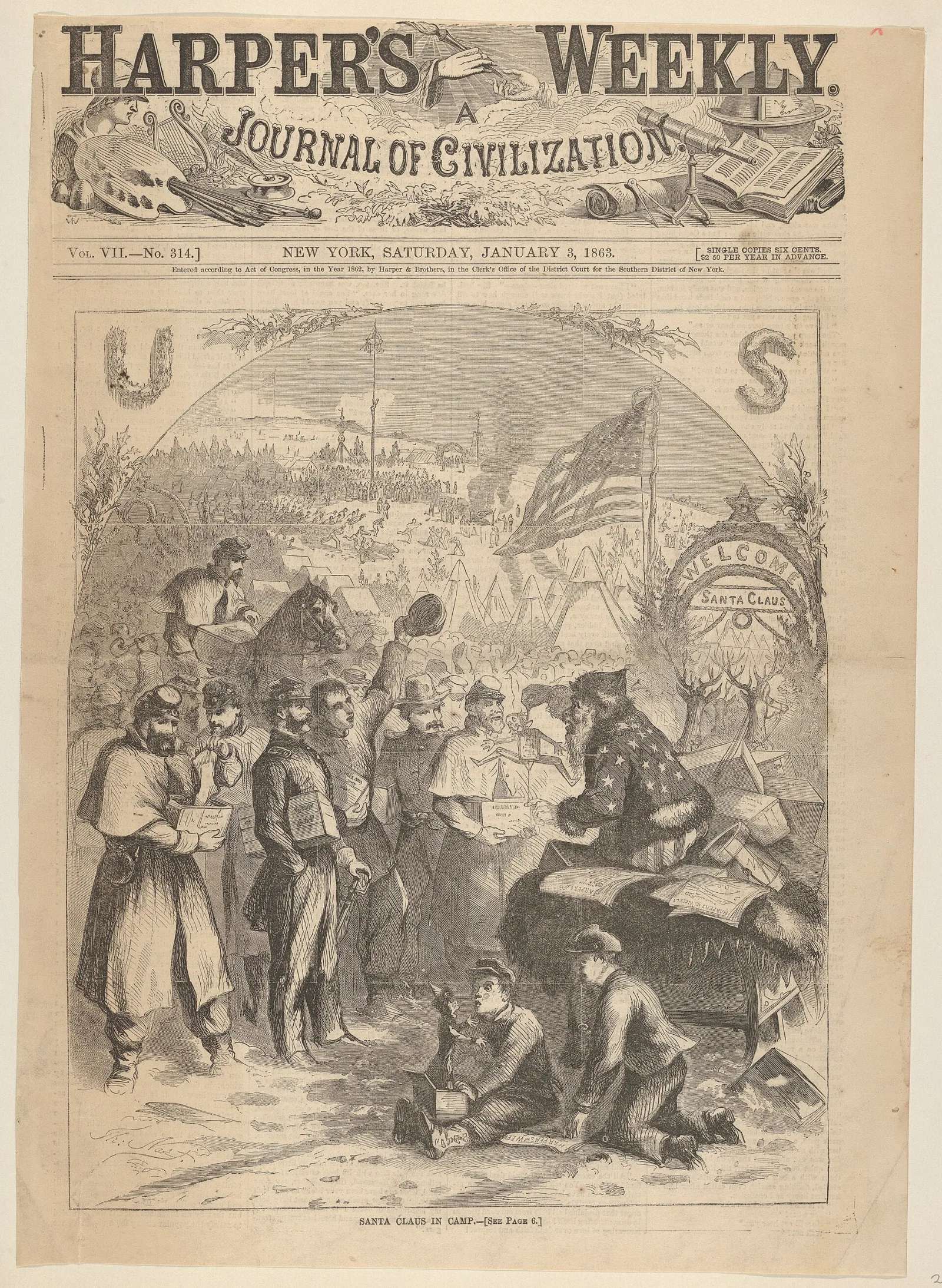
- 1863Thomas Nast draws Santa for Harper's Weekly for the first time.
- 1870Christmas becomes a federal holiday, at first for federal workers in Washington, D.C.
- 1955A misprinted phone number starts the tradition of tracking Santa on Christmas Eve.
How Santa got his look
The American Santa grew out of St. Nicholas, a 4th-century bishop of Myra known for secret gift-giving, by way of Dutch and German traditions brought by immigrants.
The poem "A Visit from St. Nicholas" (1823), attributed to Clement Clarke Moore, gave him the sleigh, the eight reindeer and the trip down the chimney. Cartoonist Thomas Nast then drew him for Harper's Weekly from January 1863, in the middle of the Civil War, and over the next two decades turned him into the round, white-bearded figure Americans know today.

Did you know?
- NORAD's Santa tracker started by accident in 1955, when a Sears ad in a Colorado Springs newspaper printed the wrong phone number for Santa. Children's calls reached the Continental Air Defense Command, and Colonel Harry Shoup told his staff to give them Santa's position. NORAD has kept the tradition since 1958.
- Many families leave milk and cookies by the tree on Christmas Eve as a thank-you for Santa, and often carrots for the reindeer.
- Christmas is the only federal holiday rooted in a religious feast. The other ten mark civic or historical dates.
FAQ
Is Christmas a federal holiday?
Yes. December 25 is one of the 11 federal holidays listed in 5 U.S.C. § 6103.
Is Christmas Eve a federal holiday?
No. Presidents sometimes give federal employees December 24 off by executive order, as in 2018, 2019, 2020, 2024 and 2025, but it isn't a permanent holiday.
What happens when Christmas falls on a weekend?
For federal employees, a Saturday holiday is observed on the Friday before and a Sunday holiday on the Monday after. In 2027, Christmas falls on a Saturday, so it's observed on Friday, December 24.
Is the stock market open on Christmas Eve?
In 2026, yes, but the NYSE closes early, at 1 p.m. Eastern, on December 24. It is closed on Christmas Day.
When is the next Christmas?
On Friday, December 25, 2026.
How many days until Christmas?
There are 47 days until the next Christmas.